A kitchen remodel is consistently one of the top ROI projects in residential real estate — but not every upgrade returns equally, and what sells in Atlanta or Chicago doesn't always match what Palm Beach County buyers expect. After completing hundreds of kitchen renovations across South Florida, here's a frank breakdown of where your remodel dollars actually go to work and where they don't.
Layout and Flow Come First
Before you pick a single countertop slab or cabinet door profile, you need to honestly evaluate whether your kitchen's layout works. The classic kitchen work triangle — the relationship between your refrigerator, sink, and cooktop — still holds up as a functional benchmark. A poorly positioned island, a door that swings into the prep zone, or a refrigerator that blocks traffic flow will undermine every beautiful finish you install on top of it.
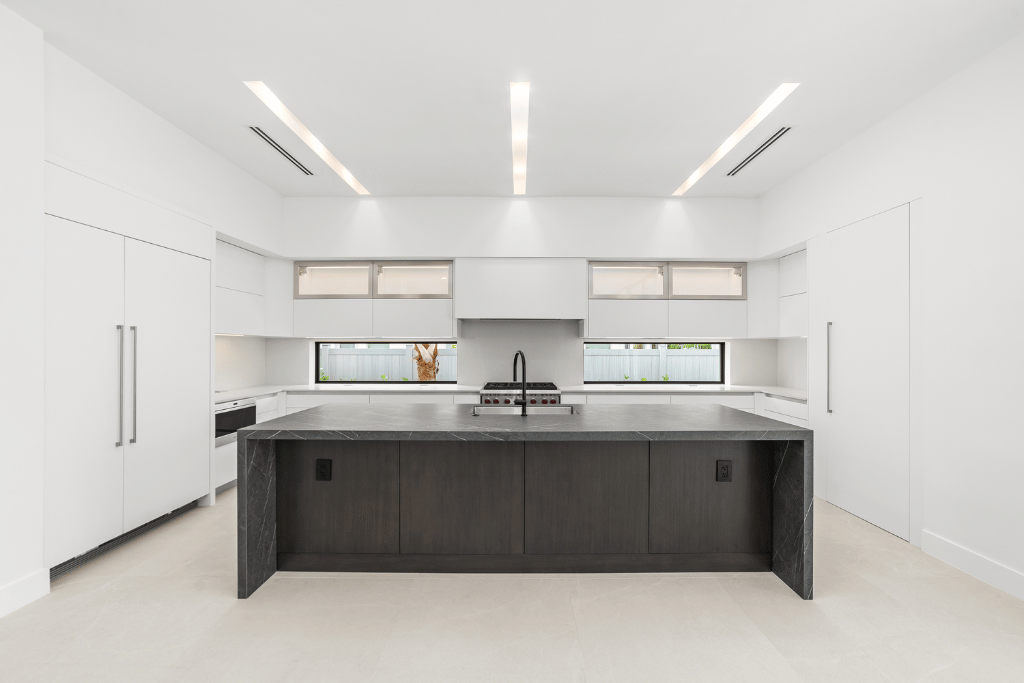
Island placement is one of the most common layout mistakes we see in remodels. An island needs a minimum of 42 inches of clearance on all working sides — 48 inches if you have multiple cooks. Too many homeowners want the largest possible island and end up with a kitchen that feels cramped the moment more than one person is in it. Buyers notice this immediately during showings, even if they can't articulate why the kitchen "feels off."
If your current layout has fundamental flow problems, the single highest-ROI decision you can make is to address them structurally — even if it means moving a wall or relocating plumbing — before investing in premium finishes. A well-laid-out kitchen with mid-tier finishes will outsell a beautiful but awkward kitchen every time.
"In Palm Beach County, buyers expect quartz counters and soft-close cabinets as a baseline — not a luxury. Meeting that expectation is table stakes for resale."
Countertops: Quartz vs Granite vs Marble
Countertop selection in South Florida is a genuine ROI decision, not just an aesthetic one. Quartz has become the dominant choice in the $600K–$2M home market for good reason: it's non-porous, requires virtually no maintenance, holds up well in Florida's humidity, and presents a consistent, clean look that photographs well for listings. In Palm Beach County's competitive resale market, quartz is effectively the expectation at mid-tier and above — not a luxury differentiator.
Granite remains a strong choice for homes above the $2M price point, particularly in dramatic book-matched slabs that read as genuinely high-end. However, granite requires periodic sealing and can be perceived as slightly dated in homes targeting younger buyers. Marble — while undeniably beautiful — carries real risk in a kitchen environment due to its susceptibility to etching from citrus and staining from oils. We advise clients who love marble to reserve it for a baking station or butler's pantry where it's less likely to see heavy daily use.
Budget-wise, quartz ranges from roughly $65 to $130 per square foot installed depending on brand and edge profile. Granite with natural movement and dramatic veining can run higher. Marble starts at $75 and climbs steeply for premium Italian stone. For most South Florida remodels targeting resale value, a mid-tier engineered quartz (Cambria, Silestone, Caesarstone) in a classic white or grey tone is the safest, highest-return choice.
The Cabinet Strategy: Reface, Recolor, or Replace?
Cabinets represent 35–50% of a typical kitchen remodel budget, so this is where you need to be strategic. The right answer depends on the condition of your existing cabinet boxes and the scope of transformation you're after. If your cabinet boxes are structurally sound (no warped frames, no water damage, doors that still hang square), refacing — replacing just the doors, drawer fronts, and applying new veneer to the exposed box faces — can deliver a dramatic visual transformation at roughly 40–60% of the cost of full replacement.
Repainting or refinishing existing cabinets is the most budget-friendly option, and in the right situation — particularly when the cabinet profile and layout are already strong — it can be highly effective. A professional spray finish in a timeless color (think Sherwin-Williams Alabaster or Benjamin Moore Chantilly Lace) with new hardware looks clean and fresh to buyers. The limitation is that you can't change the box size, layout, or add features like pull-out shelving or integrated drawer organizers without going to full replacement.
Full cabinet replacement gives you maximum flexibility: new box depths, custom interior fittings, inset vs overlay door styles, and the ability to reconfigure the layout entirely. Soft-close hinges and drawer glides are non-negotiable at this price point — they're inexpensive to include and buyers notice their absence immediately when they open a door. Whatever route you choose, plan to replace all hardware (pulls and knobs) as part of the project. It's a small cost with outsized visual impact.
Lighting: The Most Underrated Upgrade
Lighting is routinely the most underbudgeted and highest-impact item in a kitchen remodel. A kitchen with excellent cabinetry and countertops but poor lighting will photograph badly, feel smaller than it is, and leave buyers with an inexplicable sense of dissatisfaction. Conversely, a thoughtfully lit kitchen can make even mid-tier finishes look premium. The investment is modest; the return is disproportionate.
Start with under-cabinet LED lighting — it's functional, flattering, and directly illuminates your countertop workspace where you need it most. Warm white (2700–3000K) under-cabinet strips create a glow that makes countertops look richer and more inviting. Layer in recessed can lighting on a dimmer for ambient fill — avoid the single-fixture-in-the-center-of-the-ceiling approach that still plagues too many kitchens in older South Florida homes. Space your cans 4 feet apart on a grid, positioned roughly 24 inches from the cabinet faces, and put them on a separate dimmer circuit from your accent lighting.
Pendant lighting over an island is where you can introduce a design statement. Scale matters: a 36-inch-wide island typically calls for two pendants spaced 24–30 inches apart, hung at 30–36 inches above the countertop surface. Choose a finish that ties to your hardware and faucet for a cohesive look. The entire lighting package for a well-executed kitchen remodel — recessed, under-cabinet, and pendants — can often be completed for $3,000–$6,000 including electrician labor, and it's one of the best returns in the project.
Appliances: Hit the Sweet Spot
Appliances are where buyers' eyes go first, but they're also where ROI drops off most sharply at the high end. In South Florida's $700K–$1.5M home market, a well-curated suite of mid-to-upper-tier appliances — think a 36-inch GE Cafe or Bosch 800 Series range, matching dishwasher, and French door refrigerator — presents beautifully and satisfies the expectations of even discerning buyers. You do not need a Sub-Zero and Wolf package to be competitive in this segment.
The $15,000 refrigerator is the appliance where ROI breaks down most clearly. Ultra-premium integrated refrigerators require panel-front cabinetry built around them, add cost to the cabinet build, and rarely return their price in appraised value. Buyers appreciate them but won't pay a dollar-for-dollar premium. If you're staying in the home for 10+ years and want the experience of a Sub-Zero, buy it for yourself — but don't buy it as an investment decision.
Finish consistency matters as much as brand. Stainless steel remains the safest choice for resale across all price points. Black stainless had a moment but has faded as a trend. Panel-ready integrated appliances are appropriate at the $2M+ tier where the kitchen design demands a furniture-like seamlessness. Whatever you choose, make sure the entire suite — range, hood, refrigerator, dishwasher, microwave drawer — matches in finish and feels intentional. A mismatched appliance suite signals to buyers that the kitchen was assembled piecemeal, not designed.